


CES 2026 wasn’t just big; it was massive. Biggest since the pandemic, the annual Consumer Electronics Show brought together more than 148,000 attendees from across the globe.
The event saw 4100+ exhibitors, with roughly 1200+ startups showcasing breakthroughs across tech sectors. And 400+ conference sessions with 1300+ speakers.
For healthtech, this year’s show marked a shift towards AI-driven proactive care that monitors well-being before issues arise.
From that scale, here’s what stood out in healthtech at CES 2026.
Healthtech discussions that shaped CES 2026
CES 2026 saw some of the most important healthtech conversations take place. Industry leaders, regulators, and tech giants came together to discuss what’s next for healthcare.
Here are healthtech discussions that matter and what they signal for the year ahead.
The power of biowearables

One of the most talked-about moments at CES 2026 featured Lisa Earnhardt, Abbott’s Executive Vice President of Medical Devices, alongside tennis legend and entrepreneur Serena Williams.
The duo discussed the evolution of biowearables, focusing on how real-time glucose monitoring, once limited to diabetes care, is now being used by elite athletes and wellness enthusiasts to reveal metabolic trends and optimise performance.
The metabolic data has become a daily feedback loop that helps them understand how food, stress, and training affect their bodies in real time.
Biowearable tech reveals glucose trends that can help people take better charge of their health in real-time.
– Lisa Earnhardt, Abbott.
Signal for 2026:
The market is ripe for solutions that can combine health data from wearables, digital health apps, and other tools to give a complete picture of an individual’s health.
A new era of digital health
The hard truth is that healthcare innovation is moving faster than the systems meant to support it. And in this session, experts from CMS and DOGE Services focused on it.
The conversation zeroed in on how AI, smart data, and digital health tools are making care smarter, faster, and more personal. But policy, infrastructure, and payment models are struggling to keep up.
As Amy Gleason from DOGE Services stressed,
“We really have to fix our infrastructure, our internal systems, and public-facing things.”
What this signals:
For digital health to truly transform healthcare, the government, payers, and providers must unite and build a future-ready system.
Healthcare 2035: A vision for the next decade
In this forward-looking session, thought leaders Nancy Brown, Lucienne Ide, Caroline Pearson, and Glen Tullman spoke about the radical changes expected in healthcare over the next ten years.
They painted a future where healthcare shifts away from hospitals and weaves into everyday life. Data-rich technologies, AI, and connected devices will redefine how care is delivered. It’ll be faster, more personalized, and closer to the consumer. And that will happen very quickly.
As Nancy Brown put it, solving healthcare problems can’t wait decades; it needs to happen now.
It signalled that:
Healthcare by 2035 will look very different with new care delivery models. The transition toward consumer-centric ones will improve outcomes, equity, and system efficiency.
The influence of tech giants in healthcare
This discussion analysed the shifting roles of major technology firms in healthcare. Leaders from Validic, Samsung, Uber Health, and Google explored whether they’ll become partners to healthcare systems or act as disruptive competitors.
Hon Pak from Samsung highlighted that people spend nearly all their lives outside clinical settings, yet most of that data goes unseen. Tech giants bring unmatched data, platforms, and reach, and have the potential of improving health outcomes.
What this signals:
Big tech will play a central role in healthcare delivery, whether incumbents like it or not. Health systems that collaborate early may gain an edge over those that resist.
Is your health data safe?
As digital health tools become everyday essentials, this panel of regulatory experts zoomed in on the growing concerns of data security.
Andrea Abell from Eli Lilly warned,
“A lot of the things that we had trained people and thought we had control over, AI is helping to break down. So we have an increasingly complex attack surface that AI is introducing.”
With AI expanding the attack surface, protecting data privacy and strengthening cybersecurity is fundamental to ensure effective care delivery.
What this signals:
Healthtech companies that bake in strong data governance and cybersecurity will scale faster than those treating privacy as an afterthought. Trust will become a competitive advantage.
Wearables driving precision medicine
This panel highlighted how wearables are not just counting steps anymore.
Real-time biometric data from wearable sensors is fueling complex clinical decisions and highly personalised treatments. It can enable earlier interventions and more personalised care options.
As Scott Burgett from Garmin noted, access to personal health data is so powerful that it can be lifesaving.
What this signals:
Wearables are graduating from consumer dashboards to clinical-grade data platforms. They will integrate with care pathways, providers, and precision medicine models for better outcomes.
Drug discovery disrupted
Leaders from NVIDIA, Siemens, and Merck KGaA spoke on how AI, advanced cloud computing, and new digital tools are reshaping discovery pipelines.
Instead of expensive trial-and-error, companies are using existing patient data and biomarkers to identify promising therapies earlier. Laura Matz highlighted how this approach is already accelerating timelines in complex and rare diseases.
What this signals:
Pharma innovation is becoming data-first. AI-driven discovery will move from experimentation to expectation, especially in areas where traditional methods fall short.
Body-based tech
This session examined the evolution of wearables from passive trackers to tools that actively interact with the body.
From smart rings and earbuds to neurotech and immersive experiences, wearable tech is bridging the gap between humans and data.
What this signals:
The future of wearables is moving beyond just monitoring. Products that translate biology into real-time, meaningful action will define the next phase.
Home is where the health is
One of the most consistent themes across CES 2026 was the shift from clinic-first to home-first care.
With remote monitoring, smart sensors, and telehealth, healthcare is increasingly embedded in daily routines. Jim Mault from BioIntelliSense said it well:
“Now that we can see things we never saw before, it gives us the opportunity to intervene and keep them from showing up in the emergency room or ending up back in the hospital.”
What this signals:
The home will become the primary site of care. Healthtech that supports early detection and continuous monitoring will see higher demand.
Quantum Leap: Computing’s next frontier in health
Leaders from Material Impact, Cleveland Clinic, Polaris Quantum Biotech, and Carnegie Mellon spoke on the potential of quantum computing in healthcare.
Though it’s not mainstream yet, it has the power to revolutionise healthcare by solving complex problems in genomics and molecular modeling that are currently impossible for classical computers.
Sridhar Tayur pointed out,
“There is so much diversity in the human system that it is not possible to come up with a generic machine learning algorithm. We need to make it personalised.”
What this signals:
Healthcare is moving toward ultra-precision, where quantum power may enable more accurate diagnostics and highly personalized treatments.
Healthtech innovations that stood out at CES 2026
CES 2026 showcased several mindblowing healthtech innovations, from non-invasive diagnostics to continuous care wearables, here are the ones that stood out:
CES 2026 Innovation award winners in digital health
Earflo: Best of Innovation at CES 2026
Earflo was one of the best healthtech innovations at CES 2026—and truly, it deserves that award.
Earflo is a medical device designed as a sippy cup. It uses controlled air pressure to naturally open the eustachian tubes in children, potentially helping 90% of patients avoid ear tube surgery.

Dnsys for Z1 exoskeleton

Dnsys showcased the Z1 exoskeleton, a featherweight exoskeleton that adapts to how you walk by learning and adapting to your movement patterns and supporting your knees in real time.
Ceragem for Clinical One Entry System

Ceragem’s Clinical One turns building entrances into health checkpoints. Using facial recognition, its smart screening system checks for fever and vital signs.
Cosmo Robotics for Bambini (kids & teens)

A robotics-powered therapy platform designed to make pediatric rehabilitation engaging, adaptive, and data-driven.
DolbomDream’s Carearly

A camera-based remote monitoring system that tracks vital signs and stress without physical contact.
IMOON Healthcare for DeepSarco

A 3D AI diagnostic tool that detects sarcopenia early by analyzing muscle mass and body composition.
EXoPERT for Exosome-SERS-AI MCED Platform

An AI-powered liquid biopsy platform for early multi-cancer detection using exosome analysis.
InTheTech for EYAS Focus

A digital therapeutic that uses predictive AI to support attention training and ADHD care.
Eieling Technology for FattaLab®

A non-invasive diagnostic device designed to detect fatty liver disease earlier and more accurately.
Attoplex for GenHome Array

A home-based genomic testing platform that brings clinical-grade genetic screening closer to consumers.
EAN HIGHTECH for MedNeuro3D
A 3D neuroimaging solution that enhances visualization and analysis of complex brain structures.
NeuroAnimation for its NeuroAnimation Therapy

A neurorehabilitation platform using animation-based therapy to support brain recovery and motor function.
Gbrain for Phin Stim™

A neuromodulation device designed to help manage Parkinson’s symptoms through targeted brain stimulation.
XSmart Century Technology for its Sleepal® AI Lamp

An AI-powered lighting system that supports sleep quality by aligning light with circadian rhythms.
Mira for Ultra4™

A compact diagnostic platform enabling rapid, at-home testing with lab-grade accuracy.
UMED for UroRinse™ Light

A light-based medical device designed to support urinary health and infection prevention.
NeuroTx for WillSleep

A digital sleep therapy solution aimed at improving sleep quality through neuro-based interventions.
CNET’s Best of CES 2026 in digital health
Out of thousands of exhibitors at CES 2026, only a handful of products made it to CNET’s Best of CES 2026 list.
To qualify for a Best of CES award, a product must be an official CES 2026 exhibitor and do at least one of the following:
✅ Introduce a compelling new idea
✅ Solve a meaningful consumer problem
✅ Or set a new bar for performance or quality
This year, expert journalists from CNET, PCMag, Mashable, ZDNET, Everyday Health, IGN, and Lifehacker sifted through thousands of launches, from tech giants to early-stage startups, to spotlight what could shape the year ahead.
Here are the healthtech innovations that made it to the list👇

Withings Body Scan 2: A smart scale that measures 60+ biomarkers in under 90 seconds. No cuff needed.
NuraLogix Longevity Mirror: A smart mirror that uses a selfie video to analyze metabolic, heart health, and biological age in about 30 seconds.
Tombot Jennie: A robotic companion designed to bring comfort and engagement to seniors, especially those with dementia.
Dephy Sidekick: A lightweight “bionic footwear” that assists mobility and walking.
Peri: A wearable built specifically to track and manage perimenopause symptoms.
Earflo: A simple-design medical device in a sippy cup form helping kids avoid ear tube surgery.
OhmBody: A wearable neuromodulation device that helps manage menstrual cramps using targeted electrical stimulation, offering a drug-free alternative for period pain.
Allergen Alert: A portable, lab-grade food allergen detector that lets users test meals on the spot, turning food safety into preventive health tech.
Other healthtech innovations that stood out at CES 2026
Vivoo FlowPad

Vivoo introduced the FlowPad, a smart menstrual pad that turns period care into a data-driven experience.
Equipped with a microfluidic system, the FlowPad analyzes menstrual fluid to measure key hormones like FSH. Users can track fertility trends and perimenopause transitions by simply taking a photo of the pad via the Vivoo app and see insights in real time.
Samsung “Care Companion”
Samsung migrated healthtech from the wrist to the living room with its Care Companion ecosystem.
By combining Galaxy wearables with smart home devices, this suite offers:
- Speech and gait analysis to detect early signs of cognitive health decline (like dementia)
- Vision AI through TVs and kitchen cameras to detect falls or intruders, sending alerts to family members.
- Pet health screening for cataracts or dental issues by analysing pet photos
Wilder Tech Bond Ring
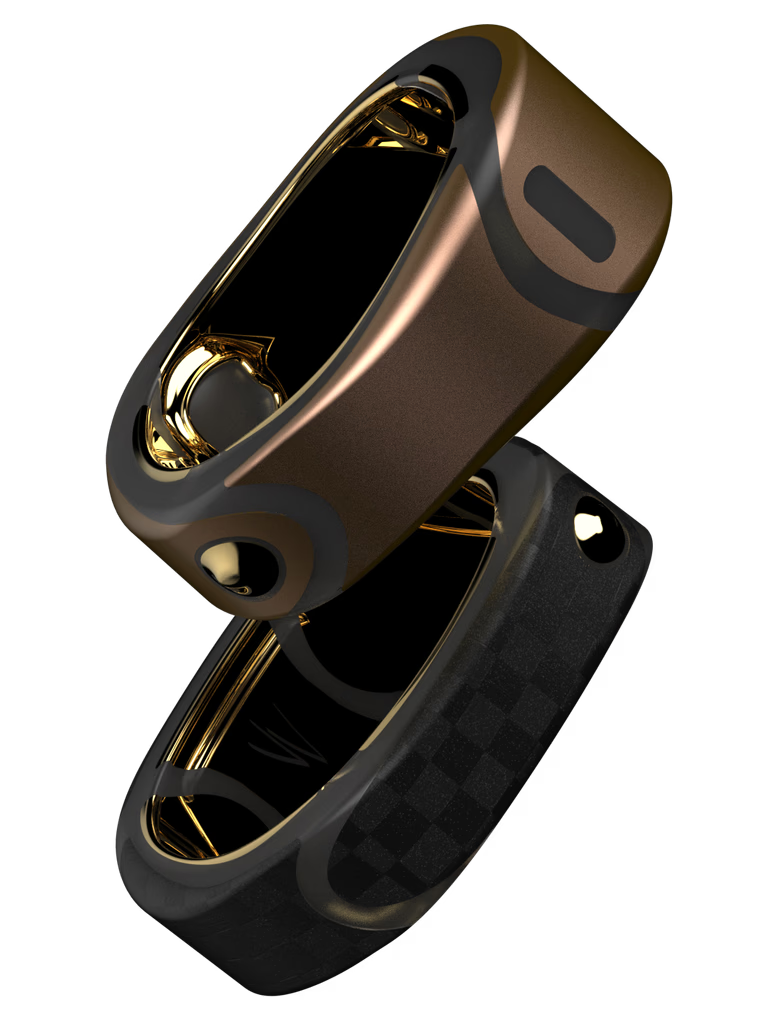
The smart wearable that needs no charging. By harvesting energy from ambient light and body heat, this ring eliminates the need for traditional charging.
And it still supports clinical-grade tracking of ECG, blood pressure, and SpO₂, representing a future where health monitoring is truly effortless.
Tactus & Reed AI: Accessibility As Innovation
CES 2026 had the first CES Accessibility stage to showcase how technology can support the 1.3 billion people worldwide living with disabilities. Innovations that stood out here:
Tactus

Showcased a wearable garment that translates sound frequencies into physical vibrations. This allows the deaf community to “feel” music through their body, redefining creative expression.
Reed AI

Introduced a platform that transforms spoken language into real-time visual patterns, specifically helping children who process speech differently to improve their pronunciation and comprehension.
Dr. Twin AI

Dr. Twin AI builds a virtual version of you using genomic and health data, flagging potential health risks before symptoms appear.
The promise is fewer emergencies, faster diagnoses, and care that starts long before a hospital visit becomes necessary.
DolbomDream and Bioconnect, turning living rooms into clinics
Camera-based monitoring systems, like DolbomDream’s Carearly and Bioconnect’s VitalTracker, showcased simple camera sensors to monitor your heart rate, breathing, and stress with clinical precision—no touch needed.
myWaves and Restful for science-backed sleep
myWaves uses personalised soundscapes to guide brainwaves, while Restful pairs that with intelligent lighting that aligns with your circadian rhythm.
Together, they choreograph sound and light to help the body move naturally from wakefulness to rest.
What CES 2026 really told us about healthtech
CES 2026 showed that healthtech is no longer about flashy gadgets or futuristic demos. It’s about care that’s proactive, non-invasive, continuous, and built for life outside hospitals.
From AI-driven diagnostics and neuromodulation wearables to home-based monitoring and data-first drug discovery, the lines between consumer tech and clinical care are disappearing fast.
The conversations showed where the system is headed. The products showed how quickly that future is arriving.
CES may be over, but the healthtech calendar is just getting started.
Stay ahead of where healthcare innovation is unfolding next. Global conferences, startup showcases, and industry-defining events.
Sign up for the All Health Tech event calendar. We track the conversations that matter, so you don’t miss what’s shaping healthtech next.


